World Congress: Foucault 40 years after
Second Call for proposals
1. Introduction
Michel Foucault died in Paris on 25 June 1984 at the age of 57. Forty years after his death, his work has continued to attract scholars and the general public. The number of books, as well as the doctoral theses, seminars, and conferences focused on his thought around the world is immense. Due to the posthumous publication of his lectures and unpublished material, Foucault’s international impact has continued increase in the last four decades. In fact, Foucault has now become a fundamental academic reference for any research in the Humanities and Social Sciences. The global impact of his work, as well as the increasing global proliferation of Foucauldian groups and networks justifies giving special significance to the forthcoming commemoration of the fortieth anniversary of his death. This is why we would like to organise a world-wide event dedicated to analysing the last four decades of intense reception of Foucault’s work but also to exploring the current repercussion of his thought. To do so, we would like to invite all researchers working on Michel Foucault’s thought to join the project of holding a World Congress in 2024 that will encompass and examine all aspects of the French philosopher’s intellectual production.
2. Methodology
The global impact of Foucault’s work has reached such an extent that it would be impossible to bring together in one place the different groups working on his philosophy. Therefore, we propose to organise a World Congress that will be held in different venues without losing a sense of unity in terms of format and themes. To make this possible, we propose to constitute an International Scientific Committee (ISC), which will receive the activity proposals from different institutions/groups. These proposals will be considered based on a set of general criteria which will establish the minimum conditions to be met. Once the proposal has been accepted, the organisers of the specific event will receive the World Congress logo, which will include the name of the city where the activity in question takes place. Information about all activities will be gathered on and disseminated through the World Congress website and social networks. This will give an extraordinary visibility to all the events. Each local activity will become part of an unprecedented global initiative which will both highlight the relevance that Michel Foucault’s thought has attained and contribute to widening the audience of readers and researchers on a global scale.
3. Criteria
Proposals will be evaluated according to the following criteria:
– Activities should focus on Foucault’s thought and be inspired by the commemoration of the 40th anniversary of his death;
– The ISC will make sure that the topics of the activities do not overlap;
– Activities should be scheduled to be carried out throughout 2024. However, activities should take place between May and June 2024 if possible;
-Activities may be organised as seminars, workshops, colloquia, or conferences, which could be held in one day or more. One-person activities are excluded;
– Online streaming of each activity is highly recommended. Event videos will be gathered on the World Congress website;
– Each activity accepted by the ISC should use the World Congress logo for promotional purposes. The name of the city in which the event in question takes place will be included on the side of the logo as the others in this site;
-Coordination of different activities that take place in the same venue is recommended. Such coordination should not affect the topic or the diversity of the participants.
– Activities at different venues in the same country are allowed.
4. International Scientific Committee Members
Daniele Lorenzini (USA)
Edgardo Castro (Argentina)
Clare O’Farrell (Australia)
Ernani Chaves (Brazil)
Santiago Castro-Gómez (Colombia)
Adán Salinas (Chile)
Sverre Raffnsøe (Denmark)
Rodrigo Castro (Spain – Coordinator)
Bernard Harcourt (USA)
Frédéric Gros (France)
Philippe Sabot (France)
Elisabetta Basso (Italy)
Yasuyuki Shinkai (Japan)
Alberto Constante (Mexico)
Jesús Ayala-Colqui (Peru)
Mateusz Ozimek (Poland)
Eugenia Vilela (Portugal)
Vanessa Lemm (UK)
Achille Mbembe (South Africa)
5. Submission of proposals
Proposals for activities should be sent to: foucault40after@gmail.com to the Coordinator of the International Scientific Committee: Prof. Rodrigo Castro. Information about activities should include:
- The title of the activity
- A short description (5 lines)
- The city and country in which the activity is to be held
- The dates on which the activity is to be carried out
- The name of the coordinator or person in charge of the activity and their e-mail address.
The deadline for submission of proposals is 2nd of February 2024.
Decisions on proposals will be communicated by the end of February 2024.
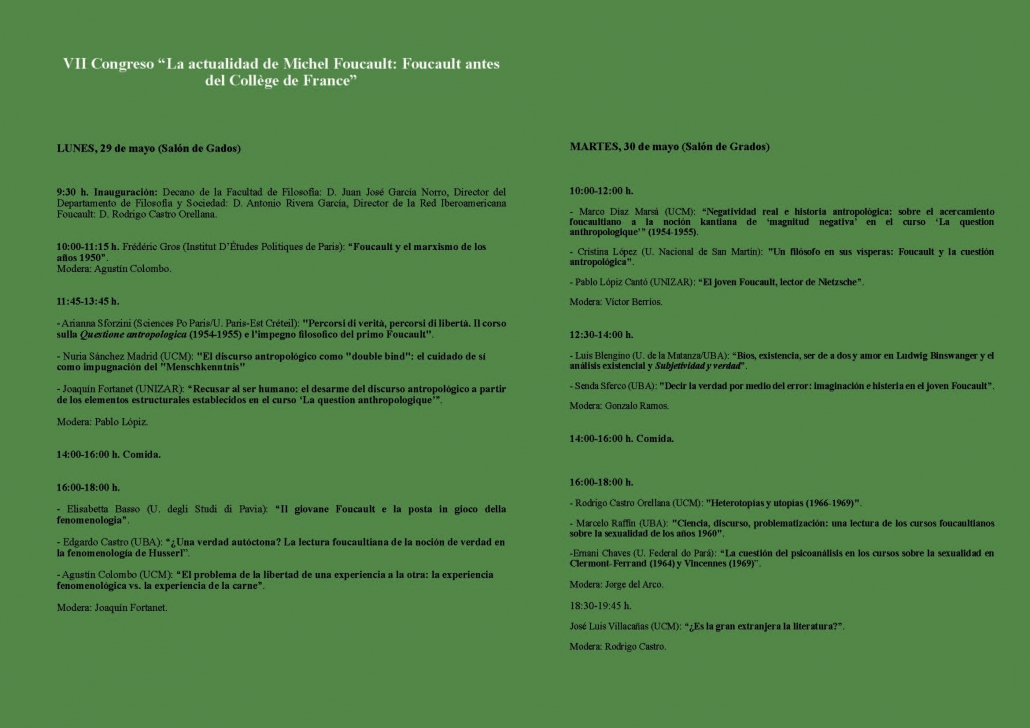
Programa del VII Congreso “La actualidad de Michel Foucault: Foucault antes del Collège de France”
LUNES, 29 de mayo (Salón de Gados)
9:30 h. Inauguración: Decano de la Facultad de Filosofía: D. Juan José García Norro, Director del Departamento de Filosofía y Sociedad: D. Antonio Rivera García, Director de la Red Iberoamericana Foucault: D. Rodrigo Castro Orellana.
10:00-11:15 h. Frédéric Gros (Institut D’Études Politiques de Paris): “Foucault y el marxismo de los años 1950”.
Modera: Agustín Colombo.
11:45-13:45 h.
– Arianna Sforzini (Sciences Po Paris/U. Paris-Est Créteil): «Percorsi di verità, percorsi di libertà. Il corso sulla Questione antropologica (1954-1955) e l’impegno filosofico del primo Foucault».
– Nuria Sánchez Madrid (UCM): «El discurso antropológico como «double bind»: el cuidado de sí como impugnación del «Menschkenntnis»
– Joaquín Fortanet (UNIZAR): “Recusar al ser humano: el desarme del discurso antropológico a partir de los elementos estructurales establecidos en el curso ‘La question anthropologique’”.
Modera: Pablo Lópiz.
14:00-16:00 h. Comida.
16:00-18:00 h.
– Elisabetta Basso (U. degli Studi di Pavia): “Il giovane Foucault e la posta in gioco della fenomenologia”.
– Edgardo Castro (UBA): “¿Una verdad autóctona? La lectura foucaultiana de la noción de verdad en la fenomenología de Husserl”.
– Agustín Colombo (UCM): “El problema de la libertad de una experiencia a la otra: la experiencia fenomenológica vs. la experiencia de la carne”.
Modera: Joaquín Fortanet.
MARTES, 30 de mayo (Salón de Grados)
10:00-12:00 h.
– Marco Díaz Marsá (UCM): “Negatividad real e historia antropológica: sobre el acercamiento foucaultiano a la noción kantiana de ‘magnitud negativa’ en el curso ‘La question anthropologique’” (1954-1955).
– Cristina López (U. Nacional de San Martín): «Un filósofo en sus vísperas: Foucault y la cuestión antropológica».
– Pablo Lópiz Cantó (UNIZAR): “El joven Foucault, lector de Nietzsche”.
Modera: Víctor Berríos.
12:30-14:00 h.
– Luis Blengino (U. de la Matanza/UBA): “Bíos, existencia, ser de a dos y amor en Ludwig Binswanger y el análisis existencial y Subjetividad y verdad”.
– Senda Sferco (UBA): «Decir la verdad por medio del error: imaginación e histeria en el joven Foucault”.
Modera: Gonzalo Ramos.
14:00-16:00 h. Comida.
16:00-18:00 h.
– Rodrigo Castro Orellana (UCM): «Heterotopías y utopías (1966-1969)».
– Marcelo Raffin (UBA): «Ciencia, discurso, problematización: una lectura de los cursos foucaultianos sobre la sexualidad de los años 1960».
-Ernani Chaves (U. Federal do Pará): “La cuestión del psicoanálisis en los cursos sobre la sexualidad en Clermont-Ferrand (1964) y Vincennes (1969)”.
Modera: Jorge del Arco.
18:30-19:45 h. José Luis Villacañas (UCM): “¿Es la gran extranjera la literatura?”.
Modera: Rodrigo Castro.
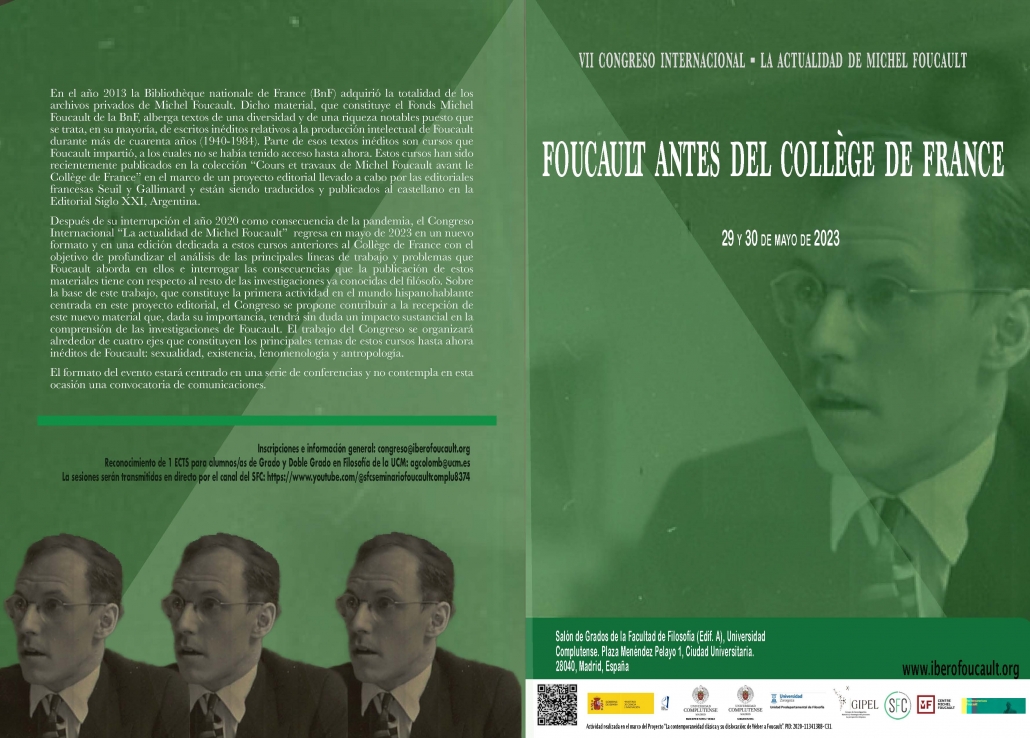
VII Congreso Internacional – La actualidad de Michel Foucault: Foucault antes del Collège de France.
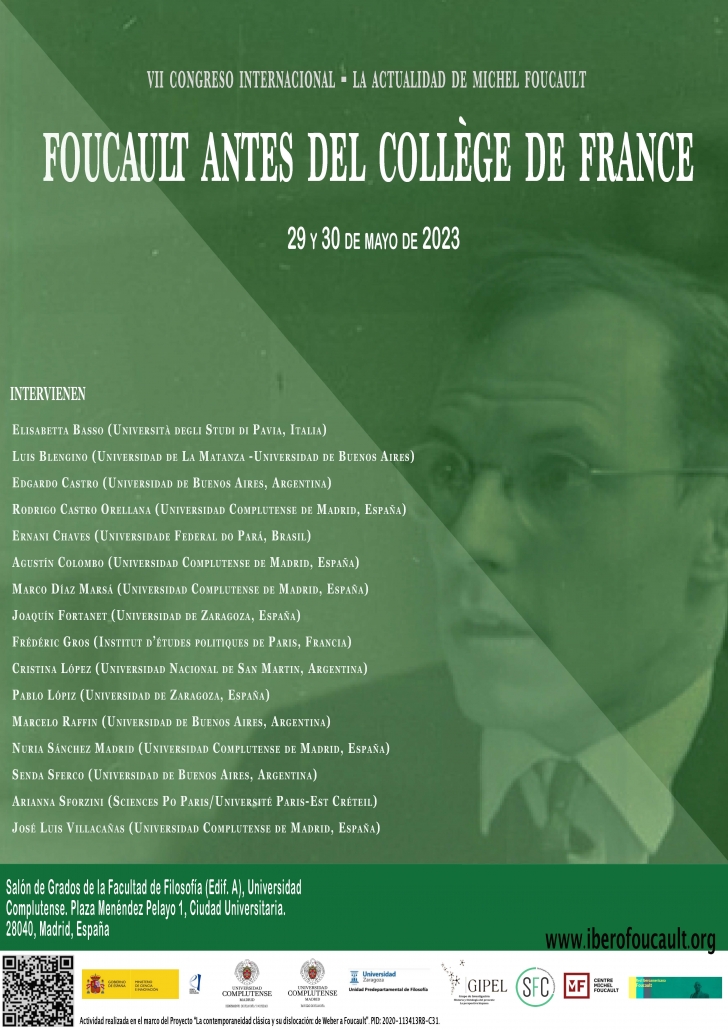
Fecha: 29 y 30 de mayo de 2023.
Lugar: Salón de Grados de la Facultad de Filosofía (Edif. A) – Universidad Complutense
Plaza Menéndez Pelayo 1, Ciudad Universitaria, CP: 28040, Madrid, España
Organizan: Red Iberoamericana Foucault, Seminario Foucault Complutense, Grupo Investigación “Historia y Ontología del Presente”.
Colaboran: Departamento de Filosofía y Sociedad (UCM), Facultad de Filosofía (UCM), Departamento de Filosofía (Universidad de Zaragoza), Centre Michel Foucault.
Actividad realizada en el marco del Proyecto “La contemporaneidad clásica y su dislocación: de Weber a Foucault”. PID: 2020-113413RB-C31.
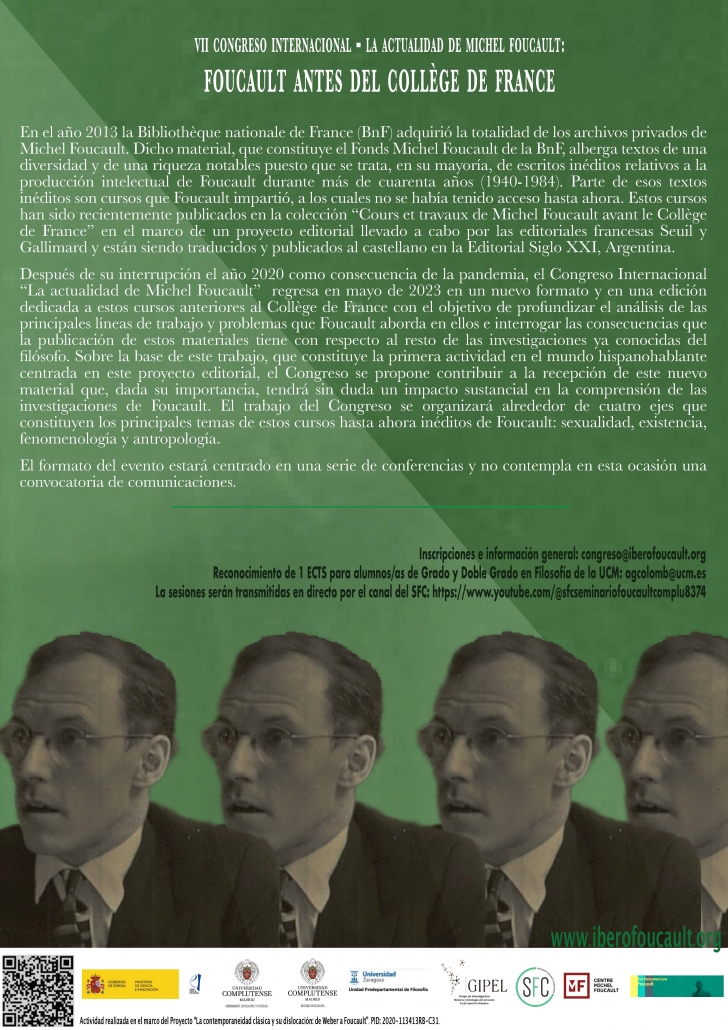
En el año 2013 la Bibliothèque nationale de France (BnF) adquirió la integralidad de los archivos privados de Michel Foucault. Dicho material, que constituye el Fonds Michel Foucault de la BnF, alberga textos de una diversidad y de una riqueza notables puesto que se trata, en su mayoría, de escritos inéditos relativos a la producción intelectual de Foucault durante más de cuarenta años (1940-1984). Parte de esos textos inéditos son cursos que Foucault impartió, a los cuales no se había tenido acceso hasta ahora. Estos cursos han sido recientemente publicados en la colección “Cours et travaux de Michel Foucault avant le Collège de France” en el marco de un proyecto editorial llevado a cabo por las editoriales francesas Seuil y Gallimard y están siendo traducidos y publicados al castellano en la Editorial Siglo XXI, Argentina.
Después de su interrupción el año 2020 como consecuencia de la pandemia, el Congreso Internacional “La actualidad de Michel Foucault” regresa en mayo de 2023 en un nuevo formato y en una edición dedicada a estos cursos anteriores al Collège de France con el objetivo de profundizar el análisis de las principales líneas de trabajo y problemas que Foucault aborda en ellos e interrogar las consecuencias que la publicación de estos materiales tiene con respecto al resto de las investigaciones ya conocidas del filósofo. Sobre la base de este trabajo, que constituye la primera actividad en el mundo hispanohablante centrada en este proyecto editorial, el Congreso se propone contribuir a la recepción de este nuevo material que, dada su importancia, tendrá sin duda un impacto sustancial en la comprensión de las investigaciones de Foucault. El trabajo del Congreso se organizará alrededor de cuatro ejes que constituyen los principales temas de estos cursos hasta ahora inéditos de Foucault: sexualidad, existencia, fenomenología y antropología.
El formato del evento estará centrado en una serie de conferencias y no contempla en esta ocasión una convocatoria de comunicaciones.
Intervienen:
Elisabetta Basso (Università degli Studi di Pavia, Italia,)
Luis Blengino (Universidad de La Matanza – Universidad de Buenos Aires)
Edgardo Castro (Universidad de Buenos Aires, Argentina)
Rodrigo Castro Orellana (Universidad Complutense de Madrid, España)
Ernani Chaves (Universidade Federal do Pará, Brasil)
Agustín Colombo (Universidad Complutense de Madrid, España)
Marco Díaz Marsá (Universidad Complutense de Madrid, España)
Joaquín Fortanet (Universidad de Zaragoza, España)
Frédéric Gros (Institut d’études politiques de Paris, Francia)
Cristina López (Universidad Nacional de San Martin, Argentina)
Pablo Lópiz (Universidad de Zaragoza, España)
Marcelo Raffin (Universidad de Buenos Aires, Argentina)
Nuria Sánchez Madrid (Universidad Complutense de Madrid, España)
Senda Sferco (Universidad de Buenos Aires, Argentina)
Arianna Sforzini (Sciences Po Paris/Université Paris-Est Créteil)
José Luis Villacañas (Universidad Complutense de Madrid, España)
Comité organizador: Rodrigo Castro Orellana, Agustín Colombo, Nuria Sánchez Madrid, Cristina Catalina, Pablo Lópiz, Joaquín Fortanet, Emmanuel Chamorro, Juan Horacio de Freitas de Silva, Elías Manzano, Gonzalo Ramos.
Web: www.iberofoucault.org/congreso
Inscripciones e información general al correo electrónico: congreso@iberofoucault.org
RECONOCIMIENTO DE 1 Crédito ECTS para alumnos/as de Grado y Dobles Grado en Filosofía de la UCM (Escribir al siguiente correo: agcolomb@ucm.es )
La sesiones serán transmitidas en directo por el canal del SFC: https://www.youtube.com/@sfcseminariofoucaultcomplu8374